


February 12, 2026
Take a moment and really look at this watch.

Felix Goldammer @GOLDAMMER YouTube
Head of Marketing
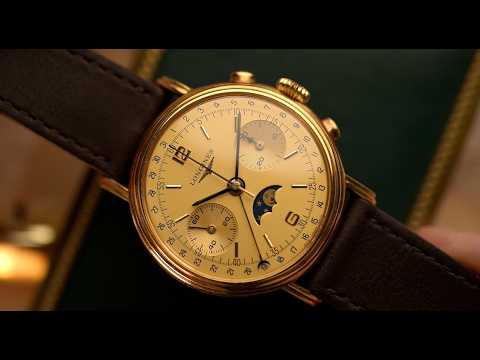
This is a Vintage Longines Chronograph Moonphase from the 1980s — reference 6574 — crafted in solid 18k yellow gold, measuring 36.5mm without crown, 44mm lug to lug, and 13mm in height.

It houses the manually wound Longines Caliber 502, features two chronograph registers (running seconds on the left, minute counter on the right), an outer date scale, and a moonphase display.
At first glance, it is simply beautiful.
The proportions are right. The gold has warmth rather than shine. The dial feels balanced, calm, and timeless. Nothing shouts. Nothing competes for attention. Everything sits exactly where it should.

But the more time you spend with this watch, the more you begin to understand it — and understanding is what changes everything in vintage collecting.
Prefer video? Watch it here
A Chronograph That Flies Under the Radar
This particular reference quietly exists beneath the surface of the vintage market while collectors chase louder names, bigger narratives, and significantly higher price tags. And that might be one of the most overlooked opportunities in vintage watch collecting right now.

Longines, especially during its golden era of chronograph production, remains deeply underestimated.
While other brands built mystique through exclusivity and limited production, Longines built credibility through engineering. Timing instruments. Aviation chronographs. Real-world performance. The brand made watches for professionals — pilots, athletes, engineers — long before the collector market turned tool watches into status symbols.
And somehow, that legacy is still not fully priced in.
Proportions & Presence
At 36.5mm, this watch perfectly illustrates why vintage proportions remain superior when it comes to complicated watches.

On an 18cm wrist, it sits exactly as it should: present, but never arrogant. Elegant, but never fragile. Gold, but never loud.
The stepped 18k case adds architectural depth when viewed from the side, while the faceted crown immediately signals that this was designed with intention rather than cost-efficiency in mind.

Over time, the case has developed a subtle patina — especially around the pushers — where the gold has taken on a slightly warmer, almost reddish tone. This is one of the quiet beauties of 18-karat gold. It is not pure gold, but an alloy, and over decades it reacts gently with air and moisture, creating a living surface that no modern polishing can reproduce.
This is the kind of aging that adds character rather than removes value.
The Dial: Controlled Complexity
The dial is where this reference truly shines.
The entire layout feels deliberate. Nothing decorative. Nothing accidental.

On the right side, the chronograph minute counter features a beautifully shaped arrow hand — a small detail, but one that adds personality without disrupting the harmony of the design. On the left, the running seconds subdial anchors the composition visually.
Longines did something particularly elegant with the hour markers. Instead of committing entirely to Roman numerals or baton markers, they combined both. Only two Roman numerals appear — the 12 and the 6 — executed in matching yellow gold, acting as visual anchors. Between them, applied baton markers keep the dial clean and modern.
On paper, that mix shouldn’t work. In reality, it works perfectly.

The outer date scale from 1 to 31 runs along the edge of the dial, paired with a dedicated date hand ending in a subtle crescent. Rather than cutting a disruptive date window into the dial, Longines preserved symmetry — and respected the overall architecture.
The golden dial itself does not reflect aggressively. It glows. It shifts in character depending on the light. It feels alive.
At the center sits the Longines winged hourglass logo — a symbol that quietly captures what mechanical watchmaking is about: time, measured and given meaning.
Step back and look at the whole composition, and it feels complete. Balanced. Honest.
Caliber 502 – The Mechanical Core
Inside beats the Longines Caliber 502, a manually wound chronograph movement that represents the final classical era of Longines chronograph construction.

The 502 did not emerge in isolation. It carries the DNA of Longines’ mid-20th century chronograph dominance, when the brand stood among the strongest chronograph manufacturers in Switzerland.
The architecture is traditional, logical, and built for longevity rather than spectacle. Clean bridges. Functional finishing. A layout designed to be serviced, worn, and passed on.

This is not watchmaking designed for Instagram macro photography.
It is watchmaking designed to last.
Why Longines Deserves More Attention
For collectors who value substance over hype, Longines remains one of the most intellectually satisfying brands in vintage collecting.

The company laid foundations that other brands later turned into marketing empires. And yet many of its vintage chronographs still trade at a fraction of comparable pieces with similar technical depth.
The spotlight is not always where true craftsmanship lives.
Sometimes, it waits quietly to be rediscovered.


Leave a comment